This study seeks to solve the following puzzle: In 1947, the Pakistan military was poorly trained and poorly armed. It also inherited highly vulnerable territory vis-a-vis the much bigger India, aggravated because of serious disputes with Afghanistan. Defence and Security were therefore issues that no Pakistan government, civil or military, could ignore. The military did not take part in politics directly until 1958, although it was called upon to restore order in 1953 in the Punjab province. Over the years, the military, or rather the Pakistan Army, continued to grow in power and influence and progressively became the most powerful institution. Moreover, it became an institution with de facto veto powers at its disposal to overrule other actors within society, including elected governments. Simultaneously, it began to acquire foreign patrons and donors willing to arm it as part of the Cold War competition (the United States), regional balance-of-power concerns (China) and ideological contestants for leadership over the Muslim world (Saudi Arabia, to contain Iranian influence). A perennial concern with defining the Islamic identity of Pakistan exacerbated by the Afghan jihad, resulted in the convergence of internal and external factors to produce the ‘fortress of Islam’ self-description that became current in the early twenty-first century. Over time, Pakistan succumbed to extremism and terrorism within and was accused of being involved in similar activities within the South Asian region and beyond. Such developments have been ruinous to Pakistan’s economic and democratic development. The following questions are posed to shed further light:
What is the relationship between the internal and external factors in explaining the rise of the military as the most powerful institution in Pakistan?
What have been the consequences of such politics for the political and economic development in Pakistan?
What are the future prospects for Pakistan?
A conceptual and theoretical framework combining the notion of a post-colonial state and Harald Lasswell’s concept of a garrison state is propounded to analyse the evolution of Pakistan as a fortress of Islam.
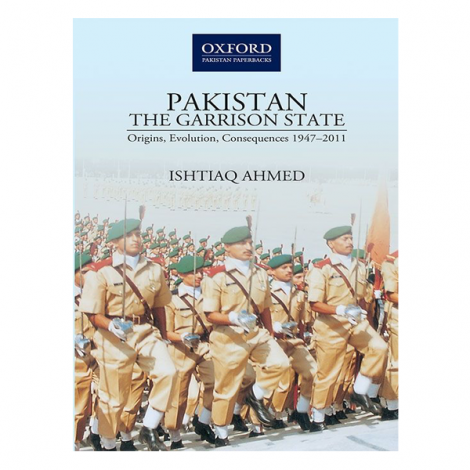
Pakistan The Garrison State by Ishtiaq Ahmed
₨2,000.00
Price Summary
- ₨2,000.00
- ₨2,000.00
- ₨2,000.00
Publication: OXFORD
Pages: 508 Paperback
Delivery All Over Pakistan Charges Will Apply.
Title May Be Different.
Due to constant currency fluctuation, prices are subject to change with or without notice.
Be the first to review “Pakistan The Garrison State by Ishtiaq Ahmed” Cancel reply
Related Products
The Emergence Of Pakistan by Ch. Muhammad Ali
Research Society Of Pakistan, PU
Delivery All Over Pakistan Charges Will Apply.
Title May Be Different.
Due to constant currency fluctuation, prices are subject to change with or without notice.
Pakistan’s Terror Conundrum by Khaled Ahmed
Description:
Pakistan was born amid communal violence and a collective consciousness of danger. Right from the outset, democracy was up for debate between the politicians nurtured by the British Raj and an orthodox clergy that advocated a utopia in which Islam was to be the ideological guide. Today, the threat of religion as an extra-legal force is causing many Pakistanis to think if the state can move forward into the future with Islam as its credo.
In this carefully curated collection of his writings in several publications, senior journalist Khaled Ahmed examines Pakistan’s policies regarding terrorism against the backdrop of increasing pressure from international organizations. Despite joining the US in its war against terror after 9/11, the country has been perceived as a safe haven and breeding ground for terrorists. Ahmed looks at the origins and activities of the various terrorist organizations, the role of the state and the ideology of its founding figures, some of whom seem to have been forgotten.
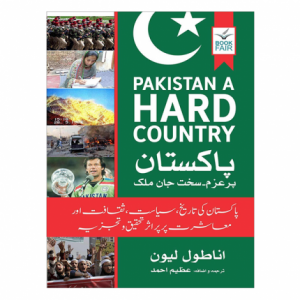
Pakistan A Hard Country by Anatol Lieven
In the past decade Pakistan has become a country of immense importance to its region, the United States, and the world. With almost 200 million people, a 500,000-man army, nuclear weapons, and a large diaspora in Britain and North America, Pakistan is central to the hopes of jihadis and the fears of their enemies. Yet the greatest short-term threat to Pakistan is not Islamist insurgency as such, but the actions of the United States, and the greatest long-term threat is ecological change.Anatol Lieven’s book is a magisterial investigation of this highly complex and often poorly understood country: its regions, ethnicities, competing religious traditions, varied social landscapes, deep political tensions, and historical patterns of violence; but also its surprising underlying stability, rooted in kinship, patronage, and the power of entrenched local elites. Engagingly written, combining history and profound analysis with reportage from Lieven’s extensive travels as a journalist and academic, Pakistan: A Hard Country is both utterly compelling and deeply revealing.
Remember:
Pages: 592
Delivery All Over Pakistan Charges Will Apply.
Title May Be Different.
Due to constant currency fluctuation, prices are subject to change with or without notice.
Eating Grass: The Making of the Pakistani Bomb 1st Ed by Feroz Khan
PDF PRINTED BOOK
Pages: 548
Delivery All Over Pakistan Charges Will Apply.
Title May Be Different.
Due to constant currency fluctuation, prices are subject to change with or without notice.
Essays On Pakistan Affairs For CSS, PMS by Soban Ch.
Publications: Caravan Book House
Delivery All Over Pakistan Charges Will Apply.
Title May Be Different.
Due to constant currency fluctuation, prices are subject to change with or without notice.
Rethinking Pakistan: A 21st Century Perspective by Bilal Zahoor
Rethinking Pakistan: A 21st Century Perspective by Bilal Zahoor & Raza Rumi
This book brings together the leading contemporary currents of thought from a galaxy of established scholars and intellectuals of Pakistan. It is a monumental contribution to the national debate on a series of crises and lingering issues that need attention of the stakeholders all around.
The book covers three major areas of investigation into public life in the country. One, it delves into the historical, sociological and cultural causes of various political conflicts, ranging from the negative role of the educational curricula for national harmony to cultural violence and persistent militarism to the curse of enforced disappearances. There are highly analytical contributions that define the conflict-resolution nexus. Two, the book is a source of inspiration on the liberal agenda of creating a scientific frame of mind, setting the feminist debate in a global context, challenging the shrinking space for media and focussing on the largely forgotten area of industrial relations. Readers will find ample issue orientation in the analysis and policy orientation in the deliberations. Three, the book enters a domain of hope, planning for a bright future and focussing on some longer-term issues couched in comprehensive new approaches to development, environment, energy, foreign policy and feminism.
The scope of the book is amazingly wide, the analysis is rich with conceptual references and empirical finding, and the scholarly idiom is comprehensible for both the articulate section of the population and the scholarly community.
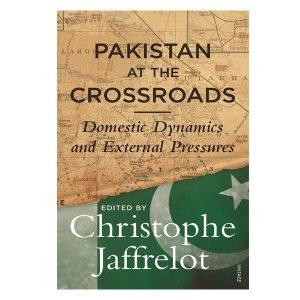
Pakistan at the Crossroads by Christophe Jaffrelot
Christophe Jaffrelot
360 pages
Delivery All Over Pakistan Charges Will Apply.
Title May Be Different.
Due to constant currency fluctuation, prices are subject to change with or without notice.
The Making Of Pakistan: A Study In Nationalism by K. K. Aziz
The Making of Pakistan (A study in Nationalism) is a profound survey of the prolific writer. He delineates in a comprehensive way the inevitable historical factors that helped shape the Muslim nationalism after multifarious events. The writer also brings to the spotlight all the other benignant causes, like the political rift between the Hindu and Muslim community that made the Muslims of subcontinent feel a dire need of a separate representative party.
Pakistan Under Siege by Madiha Afzal
Over the last fifteen years, Pakistan has come to be defined exclusively in terms of its struggle with terror. But are ordinary Pakistanis extremists? And what explains how Pakistanis think?
Much of the current work on extremism in Pakistan tends to study extremist trends in the country from a detached position—a top-down security perspective, that renders a one-dimensional picture of what is at its heart a complex, richly textured country of 200 million people. In this book, using rigorous analysis of survey data, in-depth interviews in schools and universities in Pakistan, historical narrative reporting, and her own intuitive understanding of the country, Madiha Afzal gives the full picture of Pakistan’s relationship with extremism.
The author lays out Pakistanis’ own views on terrorist groups, on jihad, on religious minorities and non-Muslims, on America, and on their place in the world. The views are not radical at first glance, but are riddled with conspiracy theories. Afzal explains how the two pillars that define the Pakistani state—Islam and a paranoia about India—have led to a regressive form of Islamization in Pakistan’s narratives, laws, and curricula. These, in turn, have shaped its citizens’ attitudes.
Afzal traces this outlook to Pakistan’s unique and tortured birth. She examines the rhetoric and the strategic actions of three actors in Pakistani politics—the military, the civilian governments, and the Islamist parties—and their relationships with militant groups. She shows how regressive Pakistani laws instituted in the 1980s worsened citizen attitudes and led to vigilante and mob violence. The author also explains that the educational regime has become a vital element in shaping citizens’ thinking. How many years one attends school, whether the school is public, private, or a madrassa, and what curricula is followed all affect Pakistanis’ attitudes about terrorism and the rest of the world.
In the end, Afzal suggests how this beleaguered nation—one with seemingly insurmountable problems in governance and education—can change course.
Remember:
Delivery All Over Pakistan Charges Will Apply.
Title May Be Different.
Due to constant currency fluctuation, prices are subject to change with or without notice.
The Pakistan Paradox by Christophe Jaffrelot
Christophe Jaffrelot
688 pages
Delivery All Over Pakistan Charges Will Apply.
Title May Be Different.
Due to constant currency fluctuation, prices are subject to change with or without notice.
Jahangir WorldTimes To The Point Pakistan Affairs For CSS PMS PCS by Dr. Liaquat Niazi
AUTHOR
Dr. Liaquat Niazi
Dr. M. Usmani
Adeel Niaz
PUBLICATION
Jahangir’s World Times Publications
Delivery All Over Pakistan Charges Will Apply.
Title May Be Different.
Due to constant currency fluctuation, prices are subject to change with or without notice.
Recently Viewed
Psychopathology 9th by David H. Barlow
BLACK & WHITE A+ Book!
Paperback, 828 Pages Edition 2023
Delivery All Over Pakistan Charges Will Apply.
Due to constant currency fluctuation, prices are subject to change with or without notice.
The Pakistan Paradox by Christophe Jaffrelot
Christophe Jaffrelot
688 pages
Delivery All Over Pakistan Charges Will Apply.
Title May Be Different.
Due to constant currency fluctuation, prices are subject to change with or without notice.


There are no reviews yet.