Paperback, 288 pages
Delivery All Over Pakistan Charges Will Apply.
Title May Be Different.
Due to constant currency fluctuation, prices are subject to change with or without notice.
₨750.00
Description:
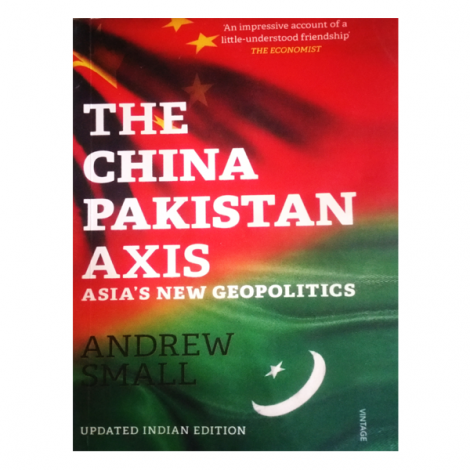
The Beijing-Islamabad axis plays a central role in Asia’s geopolitics, from India’s rise to the prospects for a post-American Afghanistan, from the threat of nuclear terrorism to the continent’s new map of mines, ports and pipelines. China is Pakistan’s great economic hope and its most trusted military partner; Pakistan is the battleground for China’s encounters with Islamic militancy and the heart of its efforts to counter-balance the emerging US-India partnership. For decades, each country has been the other’s only ‘all-weather’ friend. Yet the relationship is still little understood. The wildest claims about it are widely believed, while many of its most dramatic developments are hid- den from the public eye. This book sets out the recent history of Sino-Pakistani ties and their ramifications for the West, for India, for Afghanistan, and for Asia as a whole. It tells the stories behind some of its most sensitive aspects, including Beijing’s support for Pakistan’s nuclear program, China’s dealings with the Taliban, and the Chinese military’s planning for crises in Pakistan. It describes a relationship increasingly shaped by Pakistan’s internal strife, and the dilemmas China faces between the need for regional stability and the imperative for strategic competition with India and the USA.
Paperback, 288 pages
Delivery All Over Pakistan Charges Will Apply.
Title May Be Different.
Due to constant currency fluctuation, prices are subject to change with or without notice.
Pages: 480
Delivery All Over Pakistan Charges Will Apply.
Title May Be Different.
Due to constant currency fluctuation, prices are subject to change with or without notice.
Pages: 548
Delivery All Over Pakistan Charges Will Apply.
Title May Be Different.
Due to constant currency fluctuation, prices are subject to change with or without notice.
Delivery All Over Pakistan Charges Will Apply.
Title May Be Different.
Due to constant currency fluctuation, prices are subject to change with or without notice.
Pages : 363
Edition : 2020
Delivery All Over Pakistan Charges Will Apply.
Title May Be Different.
Due to constant currency fluctuation, prices are subject to change with or without notice.
Over the last fifteen years, Pakistan has come to be defined exclusively in terms of its struggle with terror. But are ordinary Pakistanis extremists? And what explains how Pakistanis think?
Much of the current work on extremism in Pakistan tends to study extremist trends in the country from a detached position—a top-down security perspective, that renders a one-dimensional picture of what is at its heart a complex, richly textured country of 200 million people. In this book, using rigorous analysis of survey data, in-depth interviews in schools and universities in Pakistan, historical narrative reporting, and her own intuitive understanding of the country, Madiha Afzal gives the full picture of Pakistan’s relationship with extremism.
The author lays out Pakistanis’ own views on terrorist groups, on jihad, on religious minorities and non-Muslims, on America, and on their place in the world. The views are not radical at first glance, but are riddled with conspiracy theories. Afzal explains how the two pillars that define the Pakistani state—Islam and a paranoia about India—have led to a regressive form of Islamization in Pakistan’s narratives, laws, and curricula. These, in turn, have shaped its citizens’ attitudes.
Afzal traces this outlook to Pakistan’s unique and tortured birth. She examines the rhetoric and the strategic actions of three actors in Pakistani politics—the military, the civilian governments, and the Islamist parties—and their relationships with militant groups. She shows how regressive Pakistani laws instituted in the 1980s worsened citizen attitudes and led to vigilante and mob violence. The author also explains that the educational regime has become a vital element in shaping citizens’ thinking. How many years one attends school, whether the school is public, private, or a madrassa, and what curricula is followed all affect Pakistanis’ attitudes about terrorism and the rest of the world.
In the end, Afzal suggests how this beleaguered nation—one with seemingly insurmountable problems in governance and education—can change course.
Delivery All Over Pakistan Charges Will Apply.
Title May Be Different.
Due to constant currency fluctuation, prices are subject to change with or without notice.
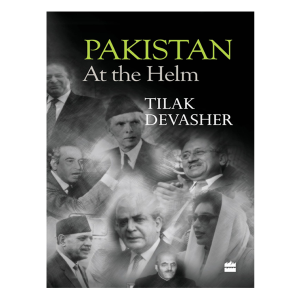
This is a meticulously researched, yet engrossing anecdotal history of Pakistan that surveys the life and times of the leaders who shaped its destiny. These include Ayub Khan, Zulfikar Ali Bhutto, Yahya Khan, Zia Ul Haq, Benazir Bhutto, Nawaz Sharif and Pervez Musharraf. The book explores their quirks and flaws which inevitably seeped into policy decisions with remarkable insight. In the process, it also sheds light on the inner workings of the corridors of power, including the dynamics of the civilian-military relationship, and the circumstances that led to the periodic transitions from democratic to military rule and vice versa.
334 Pages
Delivery All Over Pakistan Charges Will Apply.
Title May Be Different.
Due to constant currency fluctuation, prices are subject to change with or without notice.
AUTHOR
Dr. Liaquat Niazi
Dr. M. Usmani
Adeel Niaz
PUBLICATION
Jahangir’s World Times Publications
Delivery All Over Pakistan Charges Will Apply.
Title May Be Different.
Due to constant currency fluctuation, prices are subject to change with or without notice.
Mohammad Ali Jinnah was for Pakistan what Mahatma Gandhi and Jawaharlal Nehru combined were for modern India—inspirational father and first head of state. Jinnah began his career as the Indian National Congress’s ‘Ambassador of Hindu-Muslim Unity’ but ended it forty years later as the architect of the partition that split Pakistan away from India. This authoritative and uniquely insightful biography explores the fascinating public and private life of this eminently powerful but little understood leader who changed the map of the Asian subcontinent.
Portraying Jinnah’s story in all of its human complexity. Wolpert begins in the late nineteenth century with Jinnah’s early life as a provincial country-boy in Karachi and follows him to London where he studied law and became a British barrister. Returning to India in 1896, Jinnah rapidly ascended the dual ladders of Indian law and politics, climbing to the top rung of each. By the 1920s, however, it appeared that Jinnah’s political career was at an end, superseded by the rise of Gandhi’s leadership and the movement of India in a more revolutionary direction. Yet, Jinnah was to remain a pivotal figure in the turbulent decades that followed, as India struggled for independence from British rule amid growing Hindu-Muslim antagonism.
Wolpert vividly recounts how the tragic clash of personalities and party platforms that initially pitted Jinnah against Gandhi escalated from a personal rivalry into a conflict of national and international proportions. Wolpert shows how Jinnah’s shrewd and skillful leadership combined brilliant advocacy and singular tenacity to win his suit for the creation of Pakistan on behalf of the ‘Muslim nation’—his sole client during the last, lonely, pain-filled decade of his life.
In the past decade Pakistan has become a country of immense importance to its region, the United States, and the world. With almost 200 million people, a 500,000-man army, nuclear weapons, and a large diaspora in Britain and North America, Pakistan is central to the hopes of jihadis and the fears of their enemies. Yet the greatest short-term threat to Pakistan is not Islamist insurgency as such, but the actions of the United States, and the greatest long-term threat is ecological change.Anatol Lieven’s book is a magisterial investigation of this highly complex and often poorly understood country: its regions, ethnicities, competing religious traditions, varied social landscapes, deep political tensions, and historical patterns of violence; but also its surprising underlying stability, rooted in kinship, patronage, and the power of entrenched local elites. Engagingly written, combining history and profound analysis with reportage from Lieven’s extensive travels as a journalist and academic, Pakistan: A Hard Country is both utterly compelling and deeply revealing.
Pages: 592
Delivery All Over Pakistan Charges Will Apply.
Title May Be Different.
Due to constant currency fluctuation, prices are subject to change with or without notice.
Delivery All Over Pakistan Charges Will Apply.
Title May Be Different.
Due to constant currency fluctuation, prices are subject to change with or without notice.
Get access to your Orders, Wishlist and Recommendations.
Your personal data will be used to support your experience throughout this website, to manage access to your account, and for other purposes described in our privacy policy.
Shopping cart is empty!
Select at least 2 products
to compare
There are no reviews yet.