Pakistan expert and commentator Tilak Devasher trains a clear and objective gaze on the deeper malaise that affects the nation, beyond the current crises and the sensationalist headlines.
Building on several years of study and work on the region, he examines the looming water crisis, the perilous state of education, the economic meltdown and the danger of an unrealized demographic dividend that have been eating into the innards of Pakistan since its creation. He also dwells at length on the Pakistan movement, where the seeds of many current problems were sown the opportunistic use of religion being the most lethal of these.
With data-driven precision, Devasher takes apart the flawed prescriptions and responses of successive governments, especially during military rule, to the many critical challenges the country has encountered over the years. These, as much as the particular trajectory of its creation and growth, he contends, have brought Pakistan to an abyss where it risks multi-organ failure unless things change dramatically in the near future.
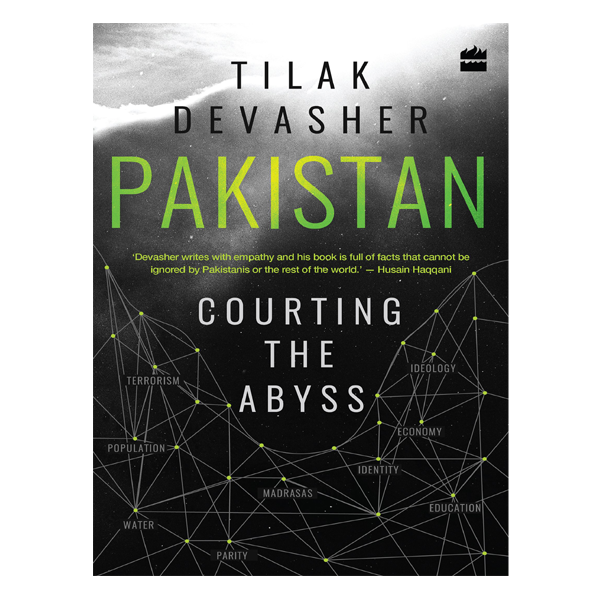
Pakistan Courting the Abyss by Tilak Devasher
₨1,250.00
Price Summary
- ₨1,250.00
- ₨1,250.00
- ₨1,250.00
Tilak Devasher
Pages: 480
Delivery All Over Pakistan Charges Will Apply.
Title May Be Different.
Due to constant currency fluctuation, prices are subject to change with or without notice.
Be the first to review “Pakistan Courting the Abyss by Tilak Devasher” Cancel reply
Related Products
Pakistan Through Crises by Tajammul Husain Hashmi
Delivery All Over Pakistan Charges Will Apply.
Title May Be Different.
Due to constant currency fluctuation, prices are subject to change with or without notice.
Pakistan: A Kaleidoscope Of Islam by Mariam Abou Zahab
Book Description:
This collection of essays brings together two sets of articles and book chapters by Mariam Abou Zahab, the extraordinary late scholar of Islam in South Asia. The first part of the volume examines Shia-Sunni relations in Pakistan, while the second concerns violent Islamism in the country, covering both the Talibanisation of the Pashtun belt and the jihadi dimension of South Asian Salafism.
Throughout these texts, Abou Zahab explores the many reasons why Pakistan has been the crucible of political Islam. She offers a historical view of this development, factoring in the impact of colonialism and conflict, including the Soviet-Afghan War and the post-9/11 Western military operations in Afghanistan. While making clear the major importance of these external influences, from Saudi Arabia and Iran to the US, she also places Pakistan’s political Islam in the context of local cultures, mobilising her anthropological erudition without ever indulging in culturalism. Finally, she emphasises the sociological determinants of sectarianism, Talibanism and jihadism, as well as the political economy of these ideologies.
Abou Zahab’s knowledge is exhaustive, but in these papers she offers an elegant synthesis in which each word matters. This volume is indispensable for understanding the present dynamics of Pakistan.
PAKISTAN: The Economy of an Elitist State Second Edition Ishrat Husain
Paperback
Delivery All Over Pakistan Charges Will Apply.
Title May Be Different.
Due to constant currency fluctuation, prices are subject to change with or without notice.
Pakistan Under Siege by Madiha Afzal
Over the last fifteen years, Pakistan has come to be defined exclusively in terms of its struggle with terror. But are ordinary Pakistanis extremists? And what explains how Pakistanis think?
Much of the current work on extremism in Pakistan tends to study extremist trends in the country from a detached position—a top-down security perspective, that renders a one-dimensional picture of what is at its heart a complex, richly textured country of 200 million people. In this book, using rigorous analysis of survey data, in-depth interviews in schools and universities in Pakistan, historical narrative reporting, and her own intuitive understanding of the country, Madiha Afzal gives the full picture of Pakistan’s relationship with extremism.
The author lays out Pakistanis’ own views on terrorist groups, on jihad, on religious minorities and non-Muslims, on America, and on their place in the world. The views are not radical at first glance, but are riddled with conspiracy theories. Afzal explains how the two pillars that define the Pakistani state—Islam and a paranoia about India—have led to a regressive form of Islamization in Pakistan’s narratives, laws, and curricula. These, in turn, have shaped its citizens’ attitudes.
Afzal traces this outlook to Pakistan’s unique and tortured birth. She examines the rhetoric and the strategic actions of three actors in Pakistani politics—the military, the civilian governments, and the Islamist parties—and their relationships with militant groups. She shows how regressive Pakistani laws instituted in the 1980s worsened citizen attitudes and led to vigilante and mob violence. The author also explains that the educational regime has become a vital element in shaping citizens’ thinking. How many years one attends school, whether the school is public, private, or a madrassa, and what curricula is followed all affect Pakistanis’ attitudes about terrorism and the rest of the world.
In the end, Afzal suggests how this beleaguered nation—one with seemingly insurmountable problems in governance and education—can change course.
Remember:
Delivery All Over Pakistan Charges Will Apply.
Title May Be Different.
Due to constant currency fluctuation, prices are subject to change with or without notice.
Pakistan at the Crossroads by Christophe Jaffrelot
Christophe Jaffrelot
360 pages
Delivery All Over Pakistan Charges Will Apply.
Title May Be Different.
Due to constant currency fluctuation, prices are subject to change with or without notice.
Essays On Pakistan Affairs For CSS, PMS by Soban Ch.
Publications: Caravan Book House
Delivery All Over Pakistan Charges Will Apply.
Title May Be Different.
Due to constant currency fluctuation, prices are subject to change with or without notice.
Jahangir WorldTimes To The Point Pakistan Affairs For CSS PMS PCS by Dr. Liaquat Niazi
AUTHOR
Dr. Liaquat Niazi
Dr. M. Usmani
Adeel Niaz
PUBLICATION
Jahangir’s World Times Publications
Delivery All Over Pakistan Charges Will Apply.
Title May Be Different.
Due to constant currency fluctuation, prices are subject to change with or without notice.
Pakistan’s Terror Conundrum by Khaled Ahmed
Description:
Pakistan was born amid communal violence and a collective consciousness of danger. Right from the outset, democracy was up for debate between the politicians nurtured by the British Raj and an orthodox clergy that advocated a utopia in which Islam was to be the ideological guide. Today, the threat of religion as an extra-legal force is causing many Pakistanis to think if the state can move forward into the future with Islam as its credo.
In this carefully curated collection of his writings in several publications, senior journalist Khaled Ahmed examines Pakistan’s policies regarding terrorism against the backdrop of increasing pressure from international organizations. Despite joining the US in its war against terror after 9/11, the country has been perceived as a safe haven and breeding ground for terrorists. Ahmed looks at the origins and activities of the various terrorist organizations, the role of the state and the ideology of its founding figures, some of whom seem to have been forgotten.
A Concise History of Pakistan by Muhammad Raza Kazmi
Description:
This is a comprehensive one-volume history of Pakistan, a country that lies at the centre of the world’s strategic concerns. Being published as Pakistan completes its sixtieth year as a nation state the book covers contemporary crises in the perspective of the subcontinent’s ancient and medieval history to explain how Muslim nationalism emerged and how the community interacted with the other communities in the region.
Covering the centuries from Mehergarh to Musharraf, the author breaches the confines of political history to depict the intellectual, economic, diplomatic, and cultural history of Pakistan. Topics that have become the subject of controversy such as the 1971 Poland Resolution and the 1972 Simla Agreement are highlighted in boxes. The book is thematically addressed, but it provides underpinning by interspersing personality profiles of the individuals who shaped the course of events over the centuries. This gallery includes Amir Khusro as the embodiment of a distinctive Indo-Muslim culture; Mahatma Gandhi and Pandit Nehru, whose lofty ideals nevertheless resulted in Partition; M.A. Jinnah, who is credited with almost single-handedly creating the state of Pakistan; and the volatile but tragic figure of Z.A. Bhutto.
In covering economic history, the author has also treated unorthodox subjects such as the rise and fall of the Bank of Credit and Commerce International and the Kalabagh Dam controversy. In diplomatic history the author presents little known material on the 1971 War and in intellectual history he examines the circumstances that caused piety to develop into terror. Replete with striking interpretations based on neglected but authentic sources, this book breaks fresh ground.


There are no reviews yet.